
I’ve been teaching Side Plank Pose recently as it’s a good basic pose for all levels. It can be modified in multiple ways to accommodate injuries and body shapes. It also offers opportunities for advanced variations and experimentation with confidence – you are already pretty much horizontal to the ground so if you do wobble you don’t have far to go!
Why practice it?
So often we neglect to strengthen or stretch the side of the body. Think of the most common exercises done with weights – up and down, front and back. There are some side raises and lifts but not targeting the deep muscles (internal obliques) within the sides of the torso. Side Planks are sometimes included within circuit classes and are usually met with groans – the sort of groans that only burpees usually bring out! So many of us, when we do have to practice Side Plank, dread it. This is where Side Plank within a yoga class can really help. As yoga is slower paced than a circuit class, there is more time to set up a pose, explore it, find peace in it and grow to love it. Yes, it is possible to actually love Side Plank Pose!
Why is it called Side Plank?
Side Plank Pose is also (less commonly) known as Sage Vasistha’s Pose, hence its Sanskrit name Vasisthasana. Vasistha became the first student and teacher of Jnana Yoga – the Path of Knowledge, using the mind to explore the nature of the mind itself and actual truth rather than truth as perception.
Whilst this may sound a bit deep and philosophical, if you think of the pose itself, we are doing something different – taking an alternative viewpoint and experiencing the world from a different angle. Whilst we are not exactly probing the nature of the mind itself, Side Plank Pose challenges us to explore what we see and feel in a different way.
Physical benefits
As the body is resisting gravity in a different plane, Side Plank Pose creates opportunities to explore the effect of gravity in an asymmetrical way across the body. Pretty much all the muscles in the side of the body closest to the floor need to activate sufficiently to maintain the neutral alignment of the spine. It strengthens and stabilises many muscle groups.
- Shoulders (infraspinatus and teres minor)
- Abdominals (internal and external obliques, and traverse abdominis)
- Back (quadratus lumborum)
- Pelvis (gluteals)
Recently Side Plank has become the subject of a study into its potential benefits for Scoliosis (curvature of the spine).1 The study conducted in 2014 by Dr Loren Fishman, found that 25 patients who practiced Side Plank on their weaker (convex) side showed a significant improvement. The patients practiced an average of 1.5 minutes per day, 6.1 days per week for 6.8 months.
Other benefits
Side Plank affects the subtle body energies as well as our mental wellbeing. The pose stimulates the Manipura Chakra – the navel centre, building inner strength, self-confidence and purpose.
The challenge of creating enduring strength, breathing steadily and maintaining focus in this pose, helps us to become more self-aware of the capabilities of our physical body and our reactions to them.
Side plank 8 ways
If you find yourself wanting to explore this pose, here are some options for you to try.*
Note: These versions of side plank are not suitable for those with shoulder, elbow or wrist issues or injuries.
Half Side Plank
- From Tabletop Pose, turn your right foot to the side of your mat, keeping your knee in place
- Place your right arm in line with your knee and extend your left leg along the mat so it also lines up with your right knee
- As you inhale, extend your left arm up, using the sides of your body to create lift
- Extend your fingertips upwards and turn your gaze upwards if your neck allows it
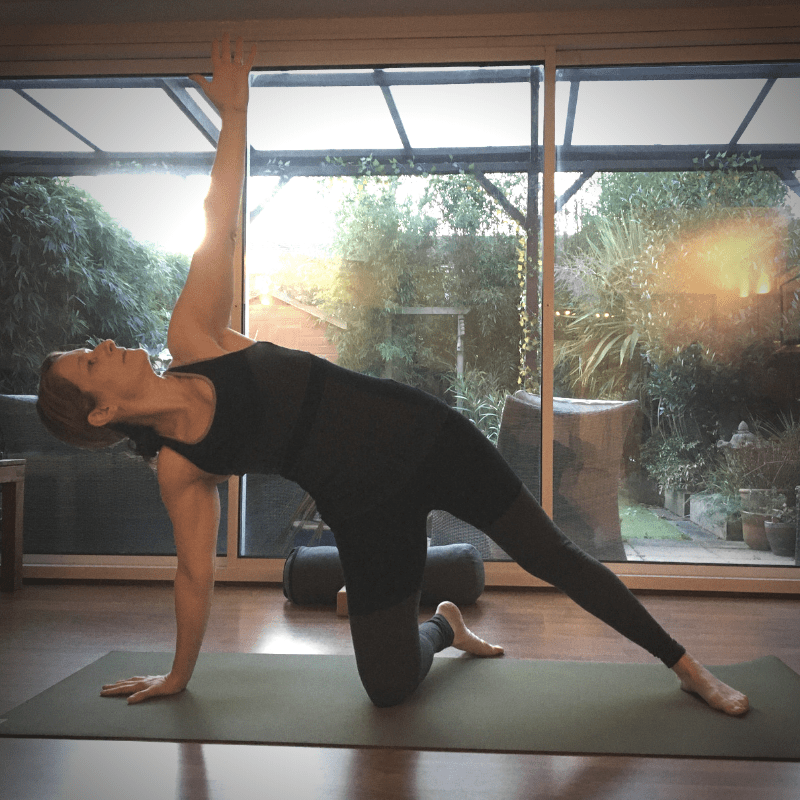
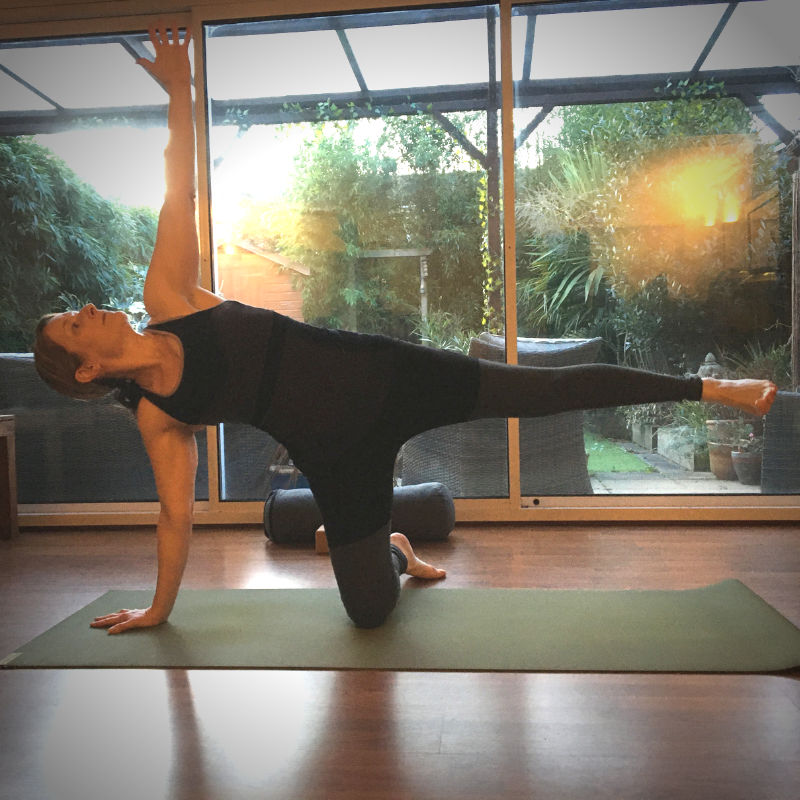
Half Side Plank with leg lifted
- From Half Side Plank, engage your straight leg and left hip
- Lift your leg until it is level with your hip (if you are able to)
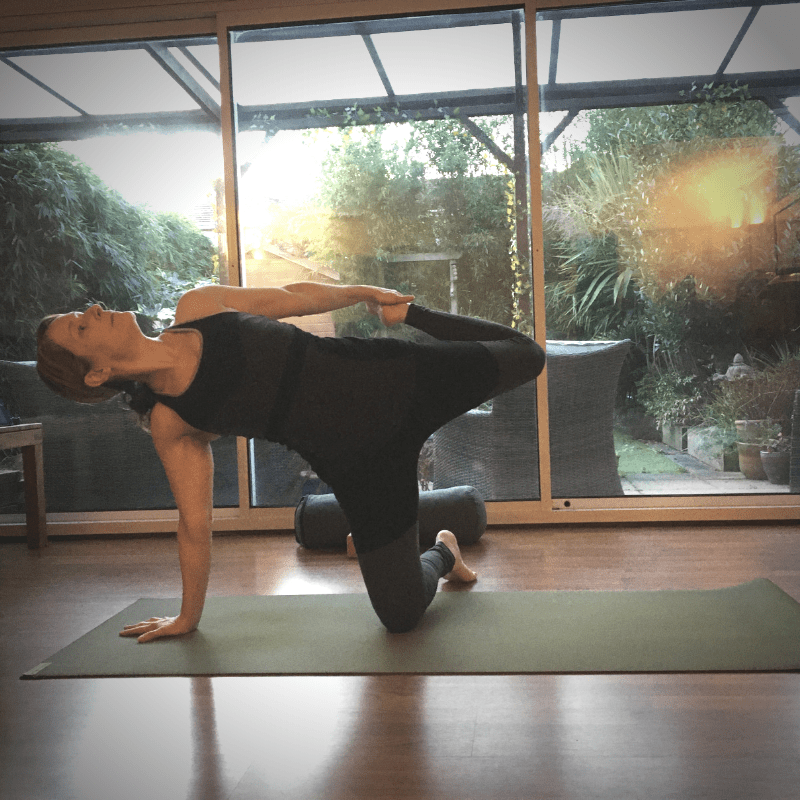
Half Side Plank with half bow
- From Half Side Plank with leg lifted, bend your lifted leg and bring your foot in close behind you
- Reach back with your uppermost arm and catch hold of the foot
- Rotate the shoulder blade in towards the spine and press the foot into your hand
- Try to keep the knee and foot at the same height as your hip – you may find the knee will try to roll inwards and the foot rises upwards
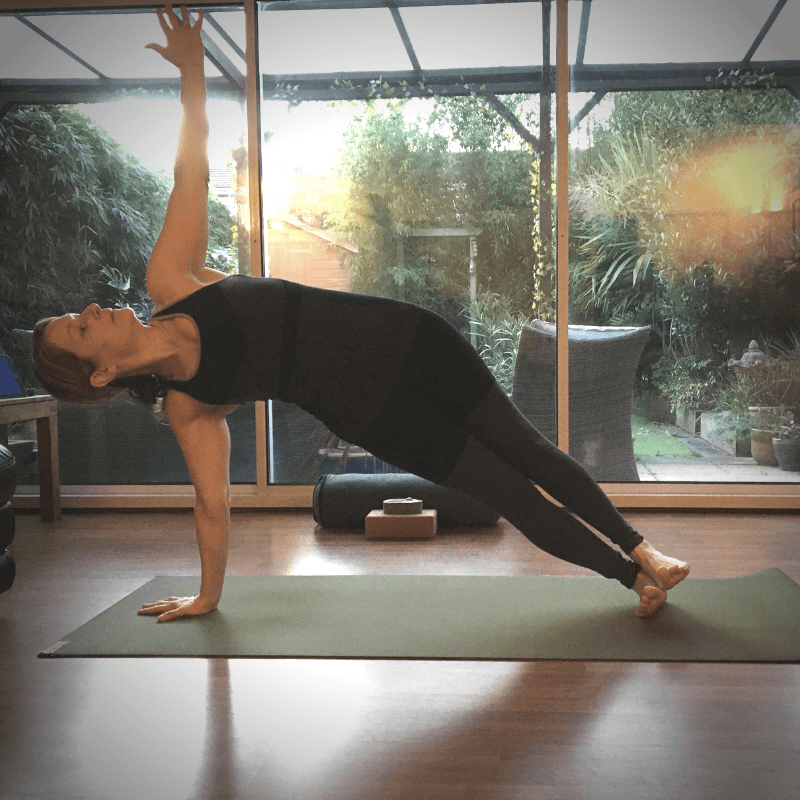
Side Plank
- Start in Plank Pose (Kumbakhasana) and place your right hand towards the midline of your body
- Turn on to the outer edge of your right foot, ensuring that the foot is flexed
- Stack the left foot on top of the right foot and as you inhale reach upwards with your left arm, engaging strongly through the abdominal muscles and lifting the hips to stabilise the spine
- Extend your fingertips upwards and turn your gaze upwards if your neck allows it
This pose can also be entered by coming into half plank first and then sliding the bent leg out along the mat. If balance is an issue you can put one foot in front of the other.
Side Plank with leg lifted
- From Side Plank, strongly engage the muscles in the lower side of the body
- Lift the top leg upwards, ensuring that the hips don’t sink down
You may be able to catch hold of your big toe and extend your foot up towards the ceiling!
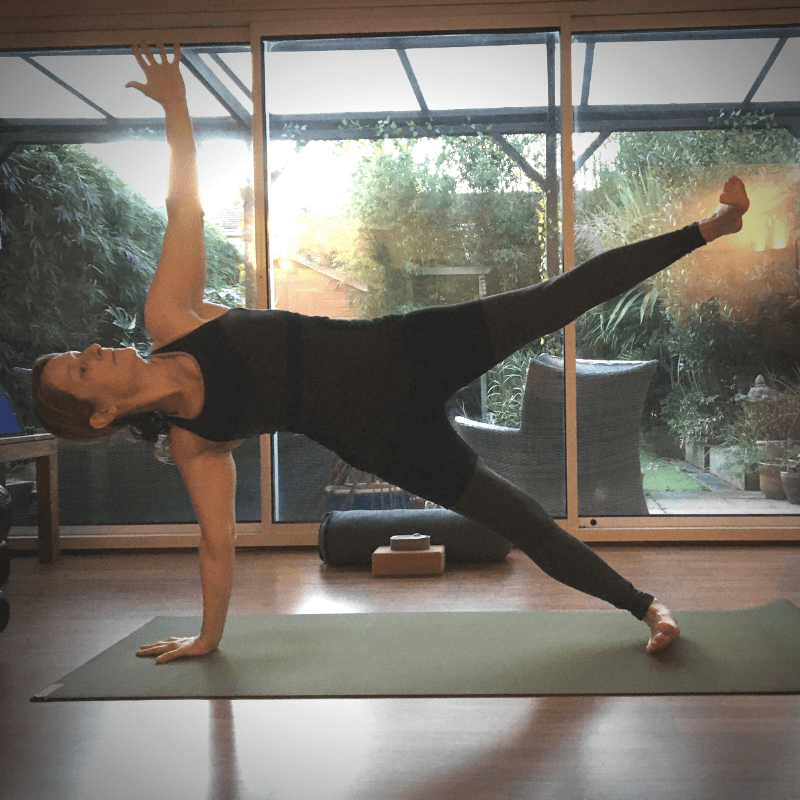
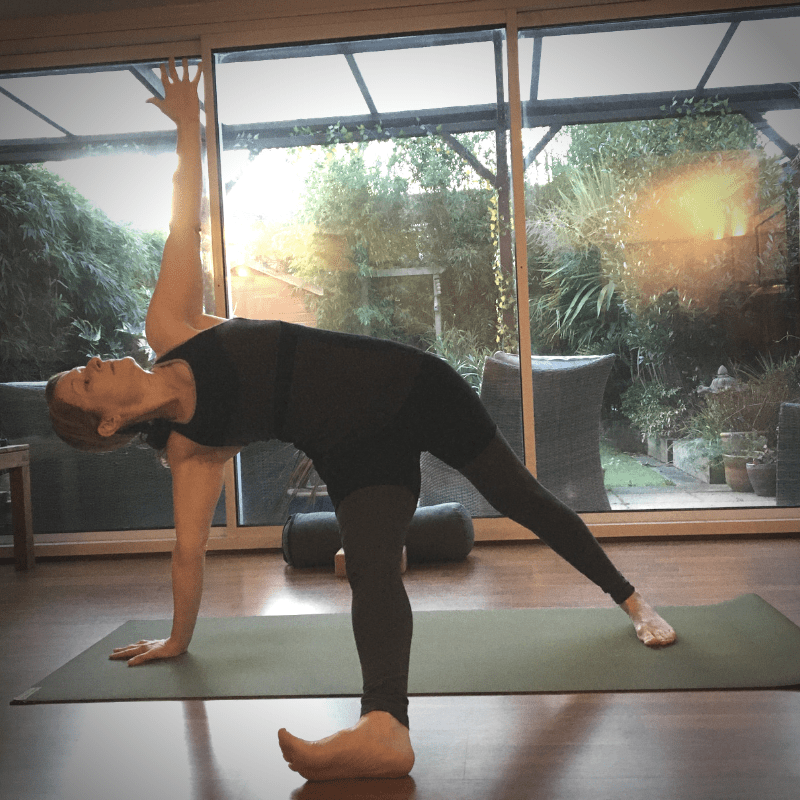
Rockstar
This isn’t really a true Side Plank but it’s a fun pose to try!
- Start in Plank Pose (Kumbakhasana) and as you exhale, draw your knee in towards your chest or belly
- As you inhale, take the leg underneath you and as you straighten it place the foot on the floor, turn your other foot to the floor and lift upwards with your opposite arm
- Keep engaging through both legs and the hips to keep them lifted
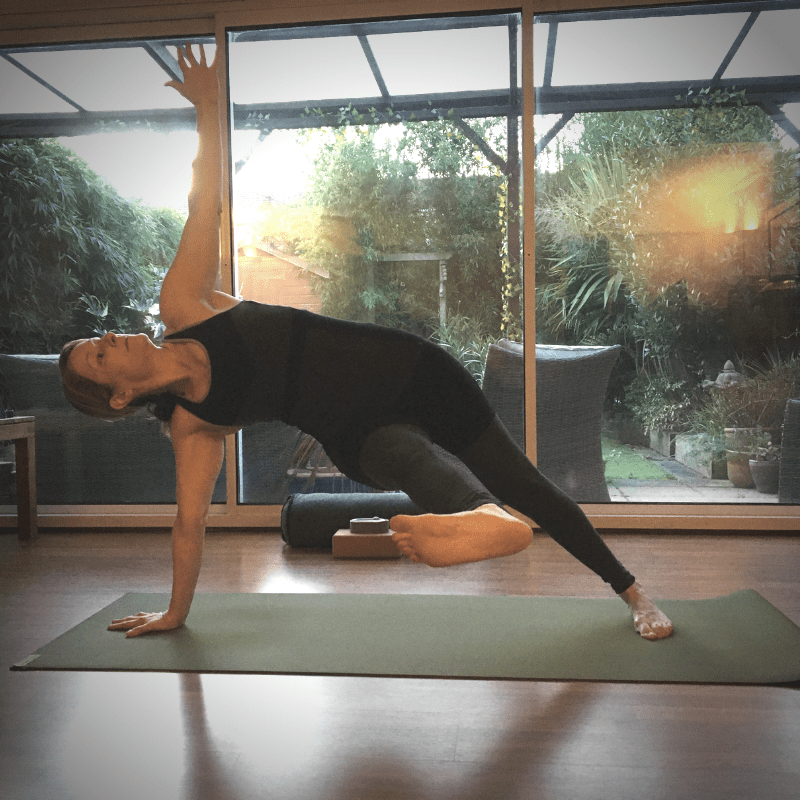
Rockstar with leg lifted
- From Rockstar, press into the grounded leg strongly and lift the crossed leg off the floor
- If the leg won’t lift, try opening more through the chest and reaching away with that leg – don’t worry if it doesn’t happen immediately though!
- Keep engaging through the legs and lower side of the body to keep the hips lifted
Partridge Pose (Kapinjalasana)
This is a pose in its own right but makes a good progression from Side Plank. The Half Side Plank with Half Bow pose makes a good build up pose for Kapinjalasana.
- Start in Side Plank Pose and ensure you are steady and stable with hips lifting to neutralise the spine
- Lift your top leg and bend it, bringing the foot in close behind you
- Reach back with your uppermost arm and catch hold of the foot
- Rotate the shoulder blade in towards the spine and press the foot into your hand but use the hand to prevent the foot moving too far back – this is not a full half-bow shape
- Try to keep the knee and foot at the same height as your hip – you may find the knee will try to roll inwards and the foot will rise upwards
If you find yourself wobbling, try doing this pose in front of a wall. As your centre of gravity changes, your toes may touch the wall. Once you’ve caught hold of your foot, you may be able to adjust your balance once more.

Join a Jasmine Yoga class to experience Side Plank and more yoga poses!
*Please remember to consult a healthcare professional before starting any new form of exercise or if you have any pre-existing condition or injury.
Reference
- Fishman LM, Groessl EJ and Sherman KJ. Serial Case Reporting Yoga for Idiopathic and Degenerative Scoliosis. Glob Adv Health Med. 2014 Sep;3(5):16–21.

 Power Yoga and Yin Yoga | Yoga in Hertford Hertfordshire | Jasmine Yoga UK