
Are you a day-dreamer or does your mind constantly whir with a flurry of to-do lists and worries about what to cook for dinner? You are not alone and both of these can make mindfulness practices challenging – they may even stop you trying in the first place.
We have around fifty thousand separate thoughts each day – these include repetitive thoughts on the same subjects, as well as the odd random one! You can quite easily find your mind rambling (or leaping) from what to have for dinner, to reminiscing about family holidays, which leads you to an embarrassing thing that happened when you were five and finishes with the chorus of a song that you can’t stand – all in the space of a minute. It’s no wonder we find it hard to switch off!
Our minds are constantly chattering away with an internal monologue and the first step to easing that internal noise is to recognise and accept it. When you practice mindfulness you won’t have a blank brain – you will still have thoughts! The trick is to observe them from a distance rather than getting involved with them and a specific focus or visualisation can help with this.
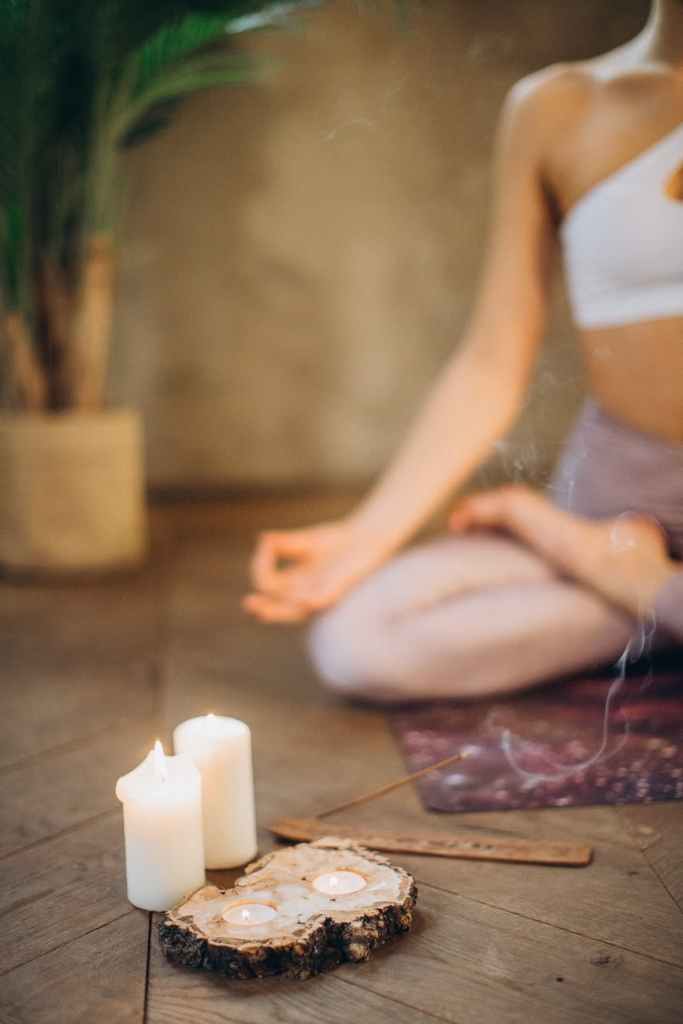
- Visualisation is creating a mental image of something
- Helps create focus for a busy mind
- Can be used during meditation and relaxation practices
Bringing your focus inwards
Our minds are focussed on our external environment, using our senses to input information to our brains. This helps us survive but also creates an endless stream of data and thoughts for us to process, which in turn trigger even more thoughts.
Turning the focus inwards, or using your inner vision or gaze, can quieten those inputs. They won’t be completely turned off and you can still notice them but won’t become entangled with them.
Try the practice below – see how you feel and what you notice before and afterwards.
- Sit on the floor or in a chair
- Close your eyes
- Notice how your body mind and breath feel without any judgement
- Relax each part of your body starting with the head and ending with the feet
- If thoughts intrude, acknowledge them and let them pass without getting involved
- Allow your breath to flow naturally, inhaling and exhaling through your nose
Doing the above before your mindfulness practice can help to create stillness, quieten the nervous system and allow your mind to become more focussed on the present moment.
Visualisations for meditation and relaxation
The visualisations below can be used as a complete mindfulness practice or in conjunction with meditation or visualisation. The stream and boat can be used for either but the feather visualisation is better suited to relaxation as you are lying down.
Stream and boat visualisation
- Imagine yourself in a peaceful meadow filled with wild grasses and flowers
- You are next to a gentle stream which winds its way through the meadow
- Allow yourself to notice the movement of the grass, flowers and water
- When an intrusive thought arrives you can imagine it becomes a small origami boat
- Gently place the boat into the stream and allow it to flow away with the current
- Watch the boat floating away and repeat every time you observe another thought

Feather visualisation
- Imagine you are lying in a beautiful garden on a lawn of soft grass
- Notice that there is a feather floating in the breeze above you
- The feather moves with your breath
- As you inhale, allow your belly to softly rise and imagine the feather floating up towards the sky
- As you exhale, allow your belly to gently soften back down towards your spine and imagine the feather floating downwards
- Allow the feather to move in a different way each time each time it rises and falls
Next time…
We will be taking a look at different forms of meditation and how to incorporate them into your mindfulness practice.
In the meantime, find out more about mindfulness practices and how to get started with your mindfulness practice in my previous articles.

 Power Yoga and Yin Yoga | Yoga in Hertford Hertfordshire | Jasmine Yoga UK
2 thoughts on “Visualisation for focus”