Breath control in yoga is integral to the practice. It is used whilst holding and transitioning between poses during Hatha yoga and is also one of Patanjali’s Eight Limbs of Yoga in the form of Pranayama. Pranayama originates from two Sanskrit words – prana (life force energy) and yama (control).
When starting yoga, it can often feel a bit strange to practice breath control. In a class setting it can even feel embarrassing to participate in Pranayama to start with. This is completely normal – many people feel this and this feeling does go away! Remember that everyone is actually doing the same thing and they will all have their eyes closed. No-one is looking at what you are doing or judging your performance. In this way Pranayama is a great way of truly surrendering our egos – if you can happily sit in a room panting with complete strangers then you have embraced yoga!
Finding balance with Anuloma Viloma
Anuloma Viloma (Alternate Nostril Breathing) is a balancing, gentle and calming Pranayama which encourages breath awareness. Anuloma means with hair and Viloma means against hair – if you think about breathing in and out through your nostrils which are full of hair, you are breathing in with the hair and out against the hair.
This practice calms the mind with its focus on steady controlled breathing and removes stale air from the lungs by using the full capacity of the lungs. It also brings awareness to the left and right sides of the body by balancing nasal breathing, Nadis (subtle energy channels), the nervous system and activating the left and right hemispheres of the brain.
Caution: Don’t practice this exercise during the last trimester of pregnancy or if you have a cold, flu or sinus problem. Make sure you don’t pinch too low on the nose as this could cause a nosebleed.
Firstly find a comfortable seated posture – try some out to see which ones work best for you. Traditionally, crossed legged poses such as Sukhasana (Easy Pose), Siddhasana (Perfect Pose) or Padmasana (Lotus Pose) are used for Pranayama. If you are taking one of these poses, sitting on the front of a block will tilt the pelvis and enable your back to straighten – this will help the lungs expand efficiently. If you can’t sit cross-legged take Virasana (Hero Pose) using blocks to sit on and a towel to support your ankles. If you’re unable to sit on the floor, sit up straight on a chair – this is also a great option if you want to practice at work or in places where sitting on the floor may not be appropriate.
Close your eyes and sit for a few minutes to establish a steady breathing pattern.
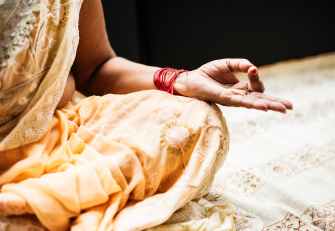
Now familiarise yourself with the Mudras (Hand Gestures) required for this exercise. Place the left hand in Chin Mudra (Conscious Breath Gesture) and raise the right hand in Vishnu Mudra (Gesture of Lord Vishnu). Rest the backs of the hands on the legs, draw the elbows back, lengthen the back and imagine the top of your head reaching towards the sky.


- Press your right nostril closed with your right thumb and exhale strongly through your left nostril. Make sure your right elbow isn’t lifted too high away from the body. Remember to keep your face forwards as sometimes it twists when pressing on the nostril.
- Inhale through your left nostril for a count of 2.
- Pinch the left nostril closed with the left and ring fingers of the right hand and hold the breath for a count of 8.
- Release the thumb and exhale strongly through your right nostril for a count of 4.
- Inhale through your right nostril for a count of 2.
- Pinch the right nostril closed with the thumb of the right hand and hold the breath for a count of 8.
- Exhale strongly through the left nostril for a count of 4.
- Repeat the sequence twice more – alternating the inhalation and exhalation.
When finished, allow yourself to sit for a few moments to enjoy the feeling of peace and calm.
Find out more about why breathing is so important in yoga.
Yoga poses and exercises on this website are undertaken at your own risk – if in any doubt consult a qualified yoga teacher.

 Power Yoga and Yin Yoga | Yoga in Hertford Hertfordshire | Jasmine Yoga UK
One thought on “Breathing for Yoga: Balance for mind and body”